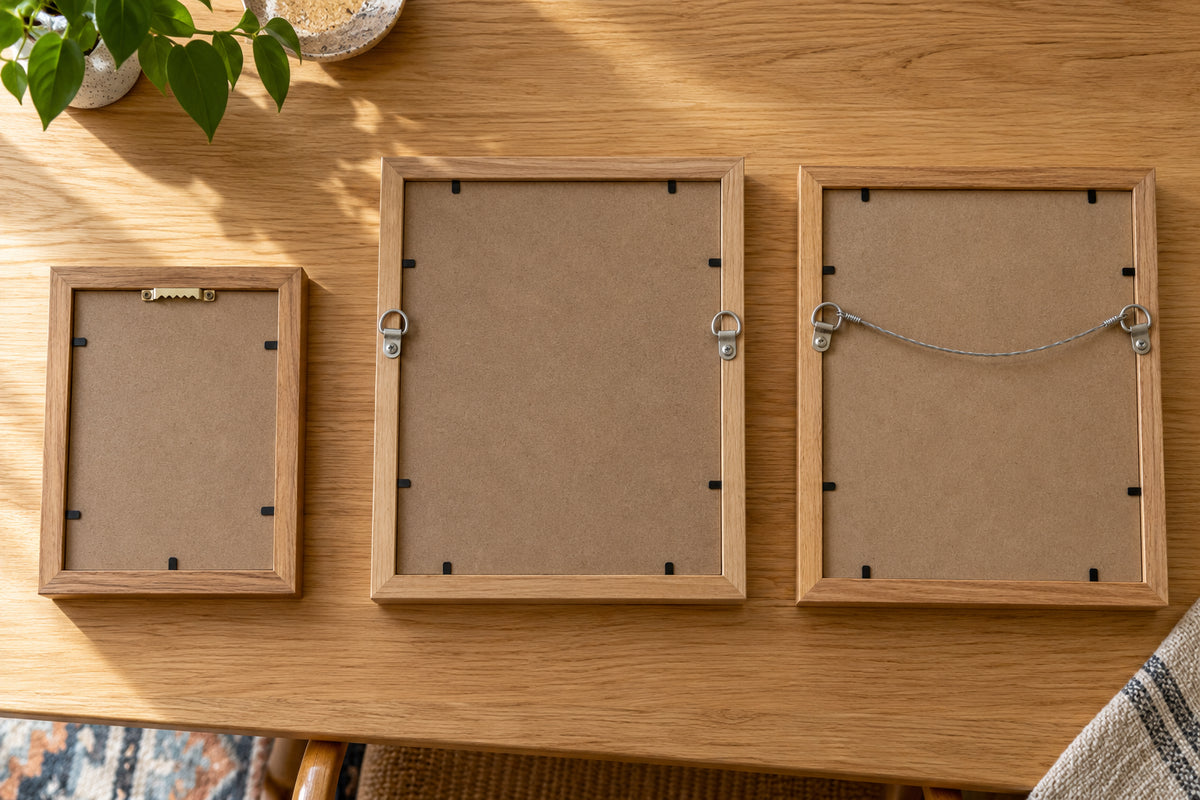
Why the Back of Your Frame Matters
Before choosing a wall hook, turn the frame over. A sawtooth hanger, a pair of D-rings, and a hanging wire each create a different support point. Identifying that support point helps you measure the placement correctly and choose compatible hardware.
There is no single best hanger for every picture. The right setup depends on the complete frame’s weight, its construction, the wall, and the instructions for the hardware. Start with the frame’s existing hanging system if it is intact and intended for the way you want to display the picture.
Frame Hardware and Wall Hardware Are Different
Frame hardware is attached to the picture itself. Examples include a serrated metal strip, metal rings, and wire connected between two attachment points.
Wall hardware is installed on the wall. Picture hooks, screws, and anchors belong to this side of the system. A frame hanger does not tell you which wall fastener to use, and a strong wall anchor cannot compensate for a damaged frame attachment.
Check the compatibility of the complete setup. A picture hook needs to engage the frame hardware properly, and the wall fixing needs to suit the wall material. Do not assume a package’s weight rating applies to every wall or installation method.
Sawtooth Hangers: A Serrated Strip Near the Top
A sawtooth hanger is usually a short metal strip with a row of notches along its lower edge. It is often positioned near the top center of a small frame. The frame hangs when a suitable wall fixing engages one of those notches.
This arrangement is common on lightweight frames. The notches allow small sideways adjustments, but the hanger’s appearance alone does not establish its load capacity. Use the specifications supplied with the frame or hanger rather than choosing a universal weight limit from a blog.
For placement, measure to the notch that will actually support the frame. The distance from that notch to the top edge is what determines the support height. Do not use the frame’s top edge as the location for the wall fixing.
If the picture keeps leaning or shifting, inspect the contact between the hanger and the wall fixing. Also check that the hanger is secure and the frame is not touching an object that pushes it out of alignment.

D-Rings: Two Attachment Points With Different Uses
D-rings are metal loops attached to the rear side rails of a frame. Some frames are designed to hang directly from the rings on two compatible wall supports. Others use the rings as attachment points for picture wire.
Those are different configurations. Follow the frame maker’s directions rather than removing a wire or adding one simply because the rings are present. A change can alter the forces on the frame and the height at which it sits.
For a direct two-point setup, measure both support locations from the frame edges. Check the vertical offset of each ring; matching-looking frames do not guarantee identical hardware placement. The wall positions should correspond to the actual supported ring positions.
Two wall supports require careful spacing. Measuring only the distance between the ring screws can miss the exact places where the rings will rest on the hooks.
Picture Wire: Measure It Under Support
Picture wire connects attachment points on the back of a frame. When the picture is lifted onto its intended wall support, the wire rises into a supported shape. The height of that shape affects where the picture lands.
Measure with the wire pulled into the position it will take on the intended support arrangement. Measuring to loose wire lying flat on the backing can produce a placement that is too high or too low.
Use wire made for picture hanging and rated for the intended application. Frayed wire, loose ends, or movement at the frame attachments need attention before hanging. Follow the supplied instructions for the wire and connectors; an improvised knot is not a substitute for the specified fastening method.
If a system calls for two wall hooks, take measurements using that configuration. Changing from one hook to two can change the supported wire height.
Compare the Three Systems
- Sawtooth: identify the supporting notch and its offset below the top edge.
- Direct D-rings: locate two actual support points and measure each one.
- Picture wire: locate the supported wire position using the intended hook arrangement.
None of these labels is a guarantee of strength. A heavy or valuable piece may need a different system chosen by the frame maker or a qualified installer.
Questions to Answer Before Hanging
Find out the weight of the complete framed piece, including glazing and backing. Confirm whether the frame is wood, metal, or another material and whether its hardware is secure.
Next, identify the wall material and review the wall hardware instructions. Drywall, plaster, brick, and concrete do not all use the same fixing method. Follow any rental or building restrictions that apply to your space.
Finally, confirm the display orientation. Hardware placed for a portrait frame may not be intended to support it horizontally. If you cannot identify the intended setup, ask the seller or a picture framer before modifying it.
Frequently Asked Questions
Are D-rings always stronger than a sawtooth hanger?
No. Capacity depends on the specific hardware, its attachment to the frame, the wall supports, and the installation. Compare the manufacturer’s specifications rather than judging by the hardware’s name.
Can I hang directly from D-rings without wire?
Some frames are designed for direct two-point hanging, while others use D-rings with wire. Follow the frame manufacturer’s instructions for the intended configuration.
Why is my picture lower than expected when I use wire?
The supported wire height may differ from the loose-wire position you measured. Recheck the offset with the wire supported in the intended hook arrangement.
Understanding the back of the frame makes the next measurement more useful. Identify the support point first, confirm the hardware requirements, and then decide where the picture should sit.