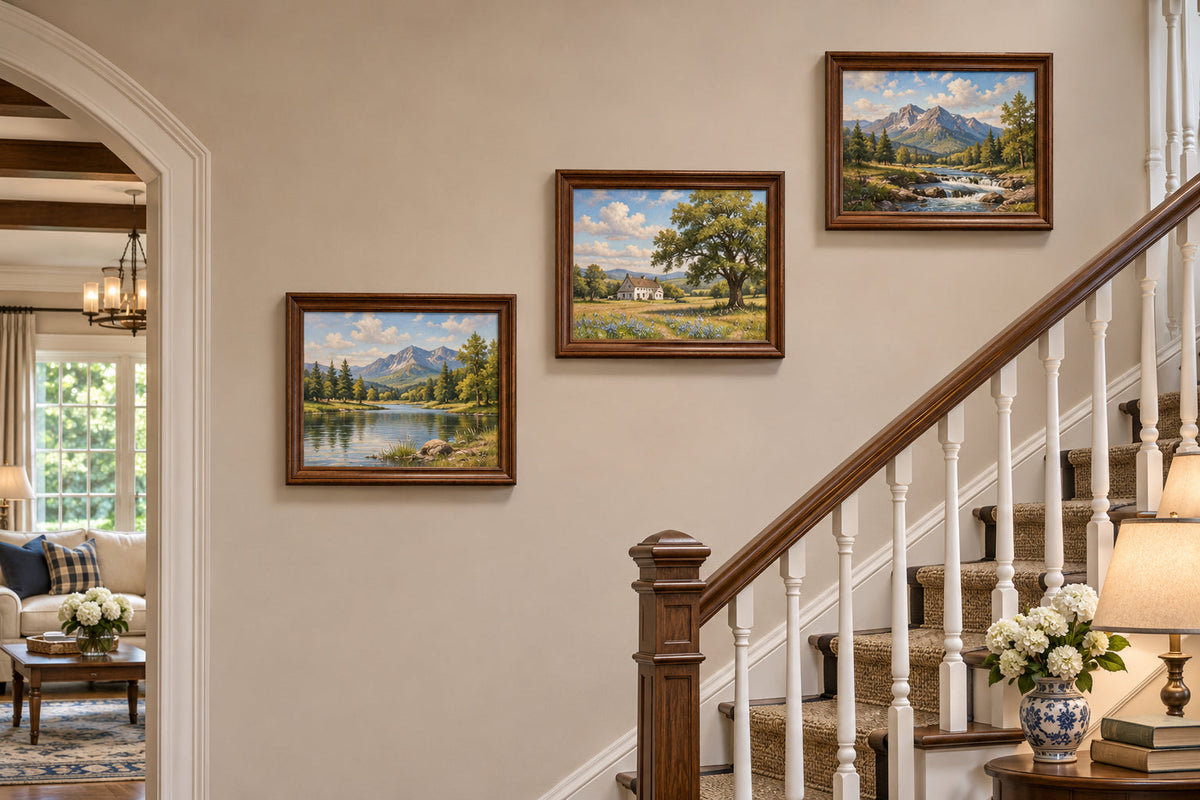
Arrange staircase wall art so the group follows the rise of the stairs while each frame stays level. Mock up the layout with paper first: a grouping that looks even from the bottom of the stairs can feel cramped near a turn or landing.
1. Choose a visual line
Pick a few steps that span the section of wall you want to decorate. Imagine a line rising with the stairs and place the centers of your frames near that line. Keep each frame level on its own; the group rises, but the frames do not tilt.
For three matching frames, try one near the lower part of the flight, one near the middle, and one higher up. Leave a clear stretch of wall at either end. When one frame is much bigger than the others, position it first and adjust the smaller frames around it.
2. Test the layout with paper
Trace the outside of each frame on paper and mark its center. Tape up the cutouts with removable tape suitable for your wall finish. Look from the bottom, top, and any landing. Slide the outlines until the gaps look consistent from the places where you enter the stairwell.
The gap to look at is the space between neighboring frame edges, especially when one frame sits both above and beside another. Take two photos from the same spot after experimenting with the spacing. Comparing them is easier than relying on memory.

3. Treat the landing as a separate space
If there’s a turn or a flat landing, stop the rising sequence before the corner. Try a single piece or a small grouping on the landing wall and judge its height while standing on the landing. Leave some blank wall between the two arrangements.
A repeated frame finish can connect the flight and landing even when their layouts differ. For example, use light wood on both walls while letting the landing print stand alone.

4. Record the layout before hanging
Once the paper layout looks right, note each frame’s position and the distance from the frame top to its support point. Frames with matching tops can still have hardware at different heights. If a location is hard to reach safely from a stable surface, leave it empty or use a qualified installer.
Keep the handrail and walking path clear. Before committing, walk the stairs as you normally would and look for any frame placement that feels too close to the rail, a doorway, or the turn.