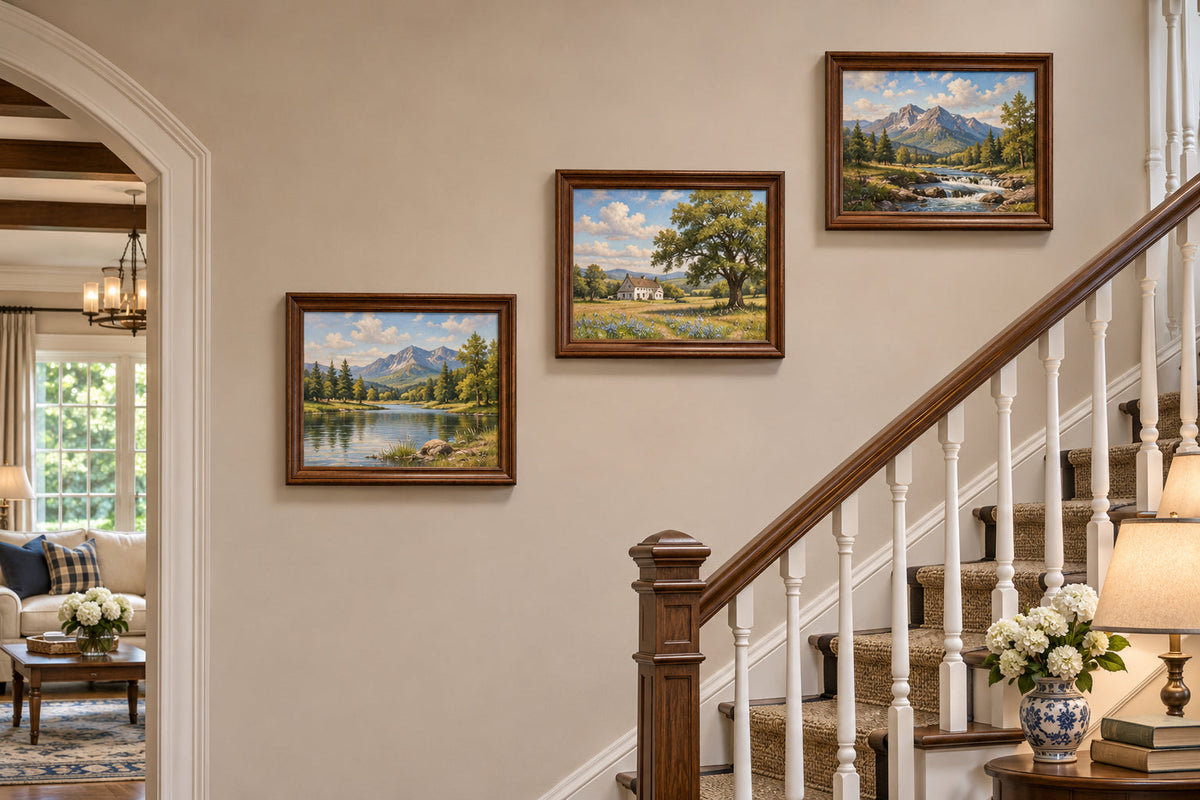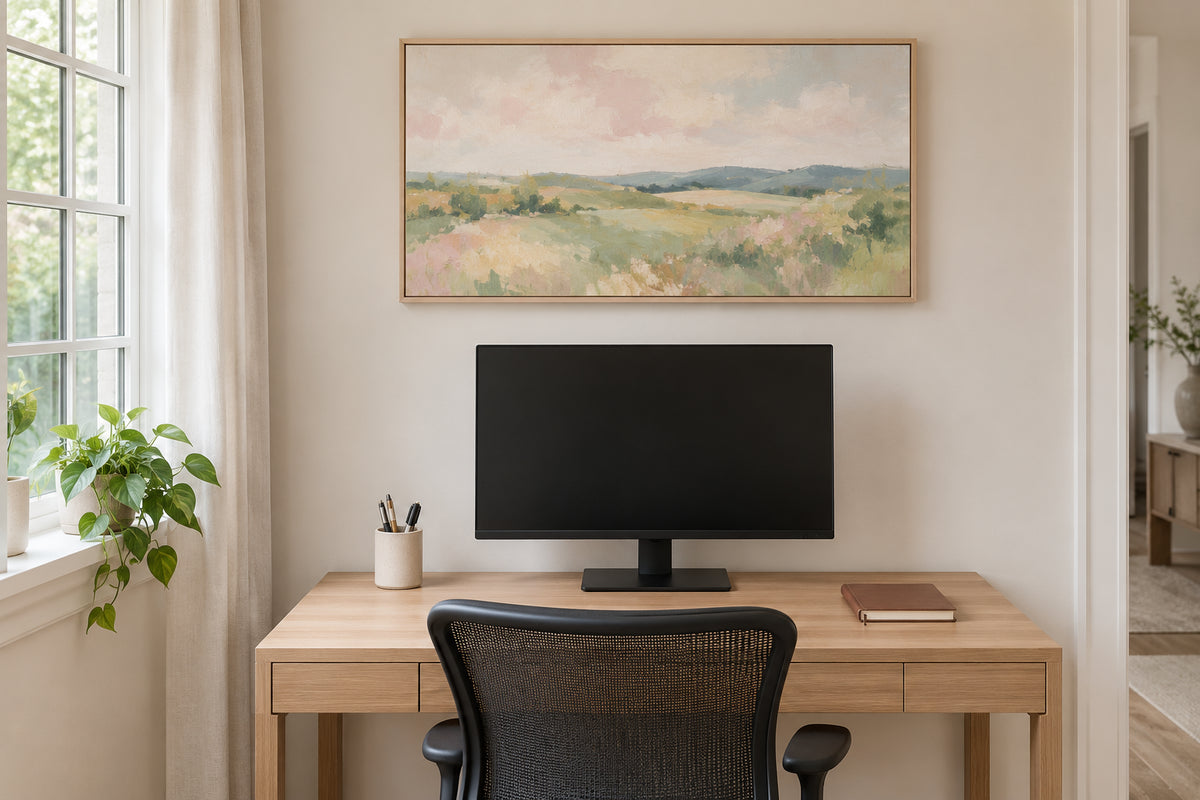
A home office can feel personal without becoming another room full of things to organize. Start with one wall, choose artwork you enjoy, and check how it fits around the equipment and furniture you use every day.
The best location is not automatically above the desk. A side wall, the space above a cabinet, or the wall behind your chair may offer a more comfortable place for a picture. Look at the workspace from your normal seat before deciding where the art belongs.
Start With the Workspace You Actually Use
Arrange the desk, monitor, lamp, and storage before planning the wall. An artwork placement that looks balanced above an empty table may stop working once the screen and everyday supplies return.
Notice which parts of the wall remain visible. A monitor can hide the bottom of a picture, while an adjustable lamp may move across it during the day. Shelves, cables, and noticeboards also affect the available space.
Take a photograph from the doorway and another from your chair. These views help you distinguish between a wall that needs decoration and a workspace that simply needs a clearer arrangement of existing objects.
Choose One Main Display Area
A small office does not need art above every surface. Begin with one area that will carry most of the visual interest, then leave the surrounding walls quieter while you assess it.
If the desk faces a plain wall, one picture above or beside the monitor may be enough. If the desk faces a window, a display above a nearby cabinet can make more sense.
In a shared living room or bedroom, consider the office corner together with the rest of the room. Repeating a frame finish or a color from nearby furniture can help the workspace feel connected without making everything match.
Plan Artwork Above a Desk Around the Equipment
When hanging art above a desk, use the complete working setup as your reference. Check the position with the monitor at its usual height and the desk in its normal configuration.
Leave the image clearly visible rather than allowing the screen to cover an important part of it. If a standing desk changes height, test the proposed placement at the positions you regularly use.
A horizontal picture can relate to a wide desk, while a smaller piece may sit comfortably to one side of the screen. Centering the art on the desk is an option, but it is not a requirement when the equipment creates an uneven arrangement.
Use a Side Wall When the Desk Wall Is Busy

A side wall can provide a home for artwork without competing with shelves, screens, or a noticeboard. It can also give you a view of the picture when you turn away from the desk.
For a narrow section, try one vertical frame or a pair of small pictures arranged above one another. Keep the grouping inside the usable wall area, with space around door trim and adjacent furniture.
Check the arrangement from your chair as well as from across the room. A picture that looks well placed when standing may sit awkwardly close to your shoulder or disappear behind an open door.
Choose Images You Want to See Repeatedly
Your office artwork does not need to advertise productivity. Landscapes, family photographs, abstract prints, botanical studies, and images connected to personal interests can all belong.
Consider how much detail you want near the working area. A busy collection may be enjoyable on a separate wall but feel visually crowded immediately around a monitor.
Avoid choosing an image only because its colors match the chair. Subject and personal meaning matter too. Start with a picture you like, then compare frame and mat options that help it fit the room.
Connect the Frames Without Making Everything Identical
For several pictures, choose one or two elements to repeat. That might be a wood tone, a thin black border, a white mat, or a shared photographic treatment.
Matching outside frame sizes can give different images a regular structure. Mixed sizes can work too, especially when the arrangement stays concentrated in one area rather than spreading around every piece of equipment.
Look at the frames alongside desk accessories. If the desktop already contains several contrasting materials and colors, a simpler wall display may be easier to balance.
Think About the Wall Behind Your Chair

The wall behind your chair may be visible from the room entrance and during video calls. A small arrangement can give it character without requiring a large collection.
Preview that wall through your camera using your usual seating position. An artwork that looks centered in the room may appear partly cropped or sit directly behind your head on screen.
Check the arrangement with your normal lighting. Keep personal documents and anything you do not want visible outside the camera view. The goal is a background you enjoy in daily life, with the camera view treated as one additional perspective.
Test the Size Before Installing Hardware
Make paper templates matching the outside dimensions of the frames. Use temporary tape appropriate for the wall finish, following its directions and testing an inconspicuous area first.
Leave the templates in place while you use the desk. Move the lamp, open nearby doors, and check the view from your chair. This reveals practical conflicts that a quick standing preview can miss.
Once the layout feels right, measure the actual support points on each frame. Choose hanging hardware suitable for the framed weight and wall type, following the installation instructions.
Common Home Office Decorating Mistakes
- Planning the wall before placing the monitor and lamp.
- Hanging a picture where equipment hides its main subject.
- Filling every available wall instead of choosing a clear display area.
- Checking the arrangement only while standing.
- Forgetting to preview the camera background when it matters to daily use.
Frequently Asked Questions
Do I need artwork directly above my monitor?
No. A side wall or the wall behind your chair may suit the room better. Choose a location that stays visible and works with your equipment.
Can I decorate the wall behind my chair?
Yes. Preview the arrangement from the room and, if you use video calls, through your camera. Check the framing with your usual seating position.
Does home office artwork have to be neutral?
No. Choose colors and subjects you enjoy. A neutral palette is one option, but a more colorful piece can work when the surrounding arrangement is considered.
Choose one display area, test it around the equipment you actually use, and give the artwork room to be seen. Your office can feel personal while still supporting the practical work of the day.